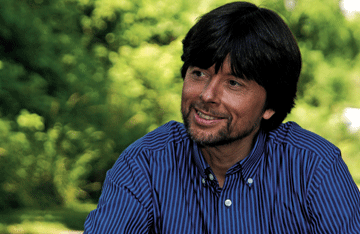
 After six years, $13 million, 600 interviews and miles of film, “The War” comes down to one message for Ken Burns.
“The primary thing,” the master documentarian explains in a very early morning conversation from the offices of his Florentine Films in Walpole, N.H., “is this undistracted sense of what it was like to be in the war.”
We have had time enough and opportunity enough to connect the dots of meaning subjectively and arbitrarily, he reasons. What he hopes his landmark, almost 15-hour examination of the so-called “Good War,” and its impact on four American towns and its people – and ultimately all of us -- offers is the experience of what took place.
“Our simple thing is ‘What was it like to be in battle?’ Not from the perspective of generals or politicians who don’t do the fighting, but the so called ordinary people who do,” he says. “Very simply that’s what we wanted to share. We were trying to bear witness to what they had experienced and just pass it along to others.”
This was, after all, “the great cataclysm in human history,” claiming 50 to 60 million lives, the “biggest thing we have ever done as a species on this planet,” Burns says. That’s why the war, for good and for bad, remains “endlessly fascinating” he suggests.
Part of his project’s resonance, he believes, is the eternal paradox of war. “War brings out the very best and very worst of us, and we are drawn to this film because we are losing 1,000 veterans a day from World War II, and this is an opportunity that won’t be with us long (to hear them tell us their stories).”
There is an urgency in families, he says, who still have surviving veterans, and those who recently lost veterans, to hear those stories told. This film, and its accompanying book, “The War: An Intimate History: 1941-1945,” (Knopf) written by Burns’ longtime associate Geoffrey C. Ward, with an introduction by Burns, is a way “to retouch” those veterans, he believes. (The book, listing at $50, has 394 illustrations and 21 maps in its 451 pages)
If there is a never ending fascination with WWII, Burns says that, in contrast, we are now engaged in a conflict in Iraq “in which we feel opposite about it.” We cannot connect daily with what is going on, he says, and, unlike WWII, everyone does not know someone in the war. “How far we’ve gotten from the (sense of) community that is essential,” he adds.
Burns says he did emerge with a different view of WWII after completing this project. “Certainly. You sort of get deposited in all that kind of mythologizing the culture does. It was a way of opening it up again and getting directly to what had happened,” he explains.
Burns writes in the book’s introduction that we need to learn about war. Do we, however, really learn the lessons of war, especially the ones that Vietnam was supposed to teach us, the ones that some say might have kept us out of Iraq?
“We don’t,” he replies quickly. There is something in humans as to why that is, he suggests. Still, he believes, “it is the responsibility of art to remind people of the arithmetic of war.” “There is something so tragically flawed in human nature. In the Civil War people were so excited that they packed picnic lunches and rode out to watch (the battle),” he adds.
We do forget the lessons of war, he says.
In the first Iraq war, “90 per cent of Americans said, ‘Let’s go to war,’ ” Burns says. “I’m not trying to make a judgment about a particular war and whether it was necessary or spurious.”
In taking on this massive project, the filmmaker says he was able to “get into the war’s dark interiors” and, in doing so, “we liberated ourselves, and hope our audience, from the conceits that get encrusted over the years.”
What such liberation does for us, he suggests, is “makes us clear eyed about the current situation, any current situation as we go through time.” “It makes us better informed citizens when we do have in democracy at least an appearance of an ability to affect if we go to war or not. We now can better decide what to get involved in and make sure it is only the necessary ones,” he adds
He is reminded of Hemingway’s observation in his introduction to “Men at War,” a massive work offering an overview of conflict through the ages. In it, Hemingway wrote that no matter to what extent we may feel a particular war is unnecessary, or how distasteful we find it, that once it begins we have no choice but to win it.
Given our country’s recent involvement in conflict, including Vietnam, Burns believes that Hemingway would revise that observation today. The set of circumstances and economic forces are different, he says, and he acknowledges that there are some who believe we are willing to, so to speak, “play to a tie” today rather than score a decided victory. “The tie plays into people who benefit economically from war,” Burns says.
At the end of the Vietnam film, “Platoon,” the character of Chris Taylor, portrayed by Charlie Sheen, offers this summation: “The war is over for me now, but it will always be there the rest of my days. Those of us who did make it have an obligation to build again, to teach to others what we know and to try with what’s left of our lives to find a goodness and meaning to this life.”
Burns’ interviewer, a Vietnam veteran, wonders aloud if he and his fellow Viet vets actually have done that, but senses Chris Taylor’s philosophy was adopted by the World War II veterans.
“I think the Vietnam veterans did that in some ways in a more impressive fashion because it was such a challenge (due to lack of support from the country, in contrast to WWII). War is one of the crudest things human beings do,” Burns replies.
Chris Taylor’s “Platoon” soliloquy is true of life itself, he adds. “It’s what we make of these bad situations and how do we go forward reminding people,” he says.
Burns’ admits to being taken aback in a most pleasant way at the overwhelming response to his own reminder of World War II through his film and book. “It is one of these magical transformations where you walk out on stage of what you think is a little community theater. That’s because of the intimacy in which you engage the subject,” he explains. “Then all of a sudden you walk out into Madison Square Garden (he laughs). People are stopping us everywhere, sending us letters exchanged between parents back then.”
Reviewers are delivering accolades that are nothing short of impressive, sometimes stunningly so.
USA Today, for example, trumpets in a headline: “Burns deserves thanks of a grateful nation.”
“It isn’t really about us,” he insists. “One of the blessings about living in New Hampshire is that celebrity and notoriety plus 50 cents gets you a cup of coffee. It isn’t really about us. It’s about the subject. If people want to put it on us, that’s OK. We are fashioners of the thing. Our interest is to get out of the way of a good story.”
Which is not to say he thinks he didn’t do a good job. “Don’t get me wrong, I’m very proud. What we were after is a deep reservoir of emotional truth that often is too scary for us to approach,” Burns says. “Often we label World War II as sentimental or nostalgic, which it is not.”
The heart of it is the shared experience, the sacrifices that are made, the people we love, the fabric of our communities and country, he believes. “If you touch that people say very nice things,” he says.
There was opportunity to touch that in a deeper way in “The War: an Intimate History, 1941-1945,” the companion volume to the television series. Geoffrey Ward deserves the lion’s share of the credit for it, says Burns who, in addition to writing the introduction, chose the photos. The spirit of the film Burns created informs the book. “It is a stand alone book. Even if there was not a film it is one of the finest books on the Second World War,” he says.
There are additional stories than are seen in the film. “We did the same thing with ‘The Civil War,’ “ he says of the book that accompanied his celebrated 1990 PBS documentary. One survey at the time cited “The Civil War” as the second most influential documentary of all time, and named Burns as one of the two most influential documentary makers of all time.
It was the highest rated series in the history of American Public Television and drew an audience of 40 million during its premiere. The New York Times hailed it as a masterpiece and lauded Burns as “the most accomplished documentary filmmaker of his generation.”
The Washington Post called it “not just great television (but) heroic television.”
Burns’ “Baseball,” his 1994 epic 18 and a half hour look at American society and the history of the sport, became the most watched series in PBS history, attracting more than 45 million viewers, winning multiple awards, including an Emmy.
He followed in 2001 with “Jazz,” which explored the culture, politics and dreams that gave birth to jazz music. Tom Brokaw called it “a masterpiece of American television,” and Jack Newfield of the New York Post said it was, “the best American documentary film I have ever seen.”
There has been much more. His “Frank Lloyd Wright,” premiered at the Sundance Film Festival, earned the prestigious Peabody Award in 1999. “Lewis and Clark,” in 1997, brought the second highest ratings in Public Television history.
His portrait of “Thomas Jefferson,” airing in 1997, examining the contradictions of the man revered as the author of the most sacred document in American history, was praised as “a considerable accomplishment.”
In 1996, Burns was executive producer and creative consultant for “The West,” an eight-part film series on the American west which received the Erik Barnouw Prize.
If someone really is his or her own hardest act to follow, it well could be Ken Burns. But, does he view it in those terms? Does he feel pressure because he already has set the bar so high for himself? How do you top yourself after being referred to as “one of the most influential documentary makers of all time”?
Burns seems to chuckle, mentioning that he already is more than half way through a film on the history of our national parks, only recently returning home after 51 days away. “It’s really hard to feel the external pressures put any more force on things than what we already do,” he says. “We have the freedom to develop these projects (on his own). Each one is unique. It’s like having kids. Because one went off and became a heart surgeon, it doesn’t mean you expect the next one to do that.”
By many standards, the three-time Emmy winner probably could have retired years ago and his place in broadcasting history, his legacy, would have been established. What continues to drive and motivate him?
“There are so many stories to tell. That’s all I am. I’m not a historian. I tell stories. I’d like to continually grow when it comes to storytelling,” says Burns, who is 54. “The War” so far has been the most complicated one for him and he is looking forward to taking on other projects.
His six-part series on the history of the national parks, focusing on the ideas and people who helped make them possible, is to air on PBS in 2009. Burns also is working on a history of Prohibition and an update to “Baseball.”
John Wilson, senior vice president and chief TV programming executive at PBS, says, “There is an honesty to Ken’s filmmaking because he treats history with respect, capturing the drama of everyday life in even the most remarkable of times.”
Burns, who has been hailed as “America’s director,” concedes that he is “an amateur historian,” but he is a filmmaker first. “I work in history the way some painters choose a particular medium in which to work. It is the arena in which I work,” he explains. “That does not mean I am not fascinated with history and mindful of the interaction (between his films).”
Is there an ultimate dream project for Ken Burns, one that he hopes to some day take on?
“Like Duke Ellington once said about his music,” Burns replies, it’s every one that I’m working on.”