 It’s a simple enough mission, perhaps, but not one that every musician can accomplish.
"All we would like to do with our music is complement people’s lives as they are already. They are already doing that for us," explains John Bell, singer-songwriter and guitarist of the long running adventurers into rock, jazz, folk and other styles who call themselves Widespread Panic.
Inspiration is the watchword, says Bell. That’s what he hopes people take from the band’s music – "inspiration in their own lives for whatever gig they have going personally."
"Our job is to be an instrument to give folks a moment of fun and release and help them explore their own internal meanderings, mental meanderings, but without pressure. If it’s just giving them a day to dance, maybe something will click in in their own lives of what they are about."
That they have been succeeding is evidenced in their frequent appearance in box office listings of the top bands on the road.
Embraced by the jam band community for their improvisational spirit, these Southern based rockers, whose new album "Don’t Tell The Band" which was released last June 19 on Sanctuary Records, prefer not to limit themselves to one community.
"The term (‘Jam band’) gets thrown around loosely just to sell a ticket a lot of times," Bell says. "If you just get down to blues musicians in the olden days, the 1940s and 1950s, those on the blues and jazz circuit, those were jam bands. They got down and improvised. As far as listening and being able to speak with their instruments, that’s the big challenge. "
Widespread, he says, is trying to do that in a rock’n’roll format. "Sometimes it’s really cool, and sometimes it’s like crazy," Bell says, laughing.
Widespread Panic first began building their devoted fan base in 1986 in Athens, Ga., where the members were going to college. They hail from many parts of the U.S., a fact that guitarist-vocalist Michael Houser, whose early nickname of "Panic" provided inspiration for the band’s name, feels provides a positive impact on the group’s artistry.
"Having a diverse group of anything always gives you something stronger than just a homogeneous mixture of something," he reasons. "There are different age groups in the band and everyone had different musical preferences growing up and different experiences in general. I think that adds something."
They quickly earned a reputation for inspired improvisation and an extraordinarily close relationship with their audiences.
As founding members of the H.O.R.D.E tour of alternative rock bands, they found new ways to take music to people.
"We miss H.O.R.D.E. We missed it even before the H.O.R.D.E. was started. That’s why we started it," says Bell. "It’s always back in some form like Lollapalooza. Anytime you get two or three or more bands together, where they are given the freedom to do what they are gonna do musically, that means giving an audience enough time to absorb these folks. It’s not like it’s a half-hour-opening slot, or something political like that.
"If you get two bands playing two hours each, or something like that, you are getting in that realm of ‘Look, we are talking about music now.’ That’s when the audience can see something different."
They can be there and see the music and see how it is approached by different bands, and really get the full flavor of what each band is doing, he says. Bell says he thinks that still happens all the time at various musical gatherings. "We’ll be doing some gigs with String Cheese Incident."
This far into the journey, Widespread Panic is challenging themselves to make it feel new, Bell says. "And we want to push ourselves individually. We don’t push each other really, but most everybody does that on their own. They push themselves just to get better and try to see whatever else you can do."
They continue to work in the musical format of six players on stage, he adds.
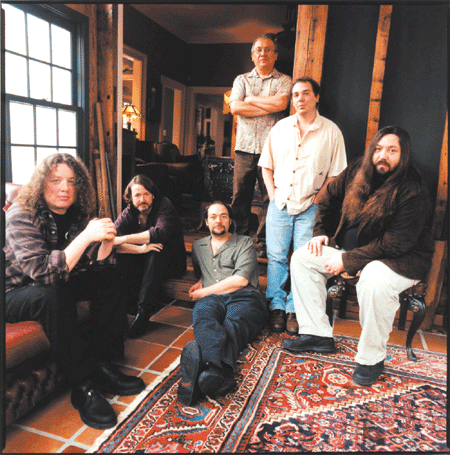
In addition to Bell and Houser, there’s John "JoJo" Hermann on keyboards and vocals; Todd Nance, drums; Domingo S. Ortiz, percussion; and Dave Schools, basses.
"The challenge is making new songs and stretching out the possibilities of music," he explains. "That’s beyond just writing new songs or writing the same song over and over again. It’s really testing the limits of scales and accessibility of notes and tones and stuff like that. But that seems like what we’ve always been up to."
It is only a challenge, he says, in that you have to decide from the beginning that you are going to do it. "Then the pay off is huge." "If you take that attitude, then all of a sudden you are circumventing a lot of boring possibilities, all of a sudden you have decided to take the road less traveled, and that’s great. It’s all discovery in music."
The fact that most of the members have been doing it together for almost 20 years "is the hippest thing," Bell says. "It’s a sense of I’m still hanging out with the kids I grew up with, where everything was new and fresh and whacked and we were young playing music and traveling around the country by ourselves in cars and U-Hauls, just seeing where you could get a gig."
They retain that feeling, he says.
Bell says the key is that Widespread Panic is a band in the true sense.
"We are not ‘Somebody and the So and Sos,’ this guy and his band or something like that. We required of each other to do whatever they can with whatever inspiration they have and add that to the mix." There is no pressure, though, he adds.
The difference between a real band and one that is not, he suggests, is that there is forgiveness and trial and error and remembering how important every person in the group is to you. "If you start to think you are the big cheese, and everybody gets that, they get excited by the crowd making a bunch of noise and it’s ‘They dig me,’ but that isn’t what created the band in the first place. That’s not what holds a band together as a band."
What Widespread panic is all about, he says, is honestly. "What we do, we do it right out there in the open."
To Bell, it’s performance instead of entertainment. "With us you are gonna get exactly where we are at that moment on stage. We are not gonna come out and give you a Vegas show. We are not gonna come out and do ‘Candyman’ just because you expect it. We won’t do it exactly the same. There’s a place for that for other folks that use the stage. But when we put on a show we are going to go through an experience and that’s what you are going to see. And we are not exactly sure what it’s going to sound or be like."
Those coming to their first Widespread Panic show will find "a lot of nice people in the audience," Bell promises.
"In our audience there is movement. That thing becomes an organism in a way. Everybody is dancing. That can be freaky for some first-timers. But it’s such a positive vibe, it’s ‘Boom!’ they get that.
"As far as what you get from the band, don’t come with any expectations and then you will be able to at least have a point of reference the next time you see a show." He laughs.
Playing live is a powerful experience for the musicians.
"You are right there in it and it’s one time," Bell says. "I love recording, because you can adjust and fix things. That’s more like working on a painting. Live, there are no fixes. You go at it with all your best intentions and you try to keep your attention very focused on what the other boys are doing, so that what happens you can hit some higher levels."
Sometimes that is exactly what happens, he says. There is revelation there, he says. "You know it’s different because it happened spontaneously without being contrived."
The band has been able to capture many of those moments on tape. "We have 48 tracks cooking every night for five or six years now, ever since the advent of digital multi-tracks," Bell says.
In recording the new album, "Don’t Tell The Band," the group’s first studio album since 1999’s " ‘Til The Medicine Takes," there were no real artistic goals, Bell insists.
"Part of the fun is to see where it takes you. We’ve got a collection of songs and ideas and things, mostly it’s a collective reflection of where we all are right now. And this time we said, ‘Hey, let’s ease up.’ ’Till The Medicine Takes’ had a lot of guest musicians. We did that on purpose. We said ‘Let’s bring it on and have a bunch of fun.’ This time it was, ‘Now, let’s scale back and be ourselves.’ "
Beyond that, the attitude is the same, he says. "We are going to play the songs that are going to come out of us. As far as I can tell with this one, there’s a little more edge, it’sa little more rock’n’roll, but there was no intention there. It just happens to be the way things are coming out."
Bell says " ’Til The Medicine Takes" was really the first album he could listen to without wishing he could have done something differently, taken a different approach to a song. "When you are in the studio you are always in the mode of looking for trouble and trying to fix it. You are looking for trouble," he says.
He believes that "Don’t Tell The Band" may surprise some people. "It may surprise those folks who think they know what Widespread Panic is," he says. "The thing is, a lot of people starting to hear us now had only heard about us second or third hand, and usually what they hear is a two or three word summation and that filters through. They might hear, ‘They are something like a jam band,’ then they go, ‘This is my idea of jam bands.’ "
The artist feels this album will reach more people who have never heard the band before. "They may go, ‘Wow! I never thought it was like that!’ Usually that’s what we hear the first time, whether it’s live or on CD. And the folks who do know us, they’ll recognize some of the bluesiness and some of the edge to it that is kind of familiar. In the album form, that gets revisited a lot."
The album was made at longtime producer John Keane’s (whose credits include R.E.M. and the Indigo Girls) studio in Athens.
Doug Trantow (Tracy Chapman, Sugar Ray and Limp Bizkit) engineered. Randall Bramblett, who played with Steve Winwood and Sea Level, added his saxophone to Widespread’s cover of "Sometimes."
"What we found in John is what we look for in a producer," says Bell. "And what we expect everytime now is his consistency, his ability to understand what we are going for, and he gives suggestions where they might apply, but still with our vision. It’s not like he is an overbearing figure that wants to decide ‘This is how I sound as a producer, so I can make any band sound like that.' "I’ve heard horror stories from other bands about other producers. It was like, ‘When did we stop being ourselves?’
"We’ve been with John a long time. We’ve watched him. He’s not only turning the knobs and creating tones and doing really cool things. He physically builds his studio, did the woodwork, the furniture, the racks that holds up his equipment, he built. When you look at it in totality, this guy is focused. He’s a real nice person with a sense of humor too. He gets the best out of people. He has seen so many bands come through there, he is unflappable."
The creative process for Widespread Panic has not change dramatically through the years. Everybody writes.
"I’m pretty lyric oriented because I do the majority of the singing. So I do like to have a little bit of say so on what the heck’s gonna come out of my mouth. (He laughs). The other guys are really good at that too. I don’t sit there and say, ‘I have to write all the lyrics,’ and there again they are not saying ‘I wrote the song. Sing it this way.’ They are open to suggestions. Usually I just have a couple of ideas and that’s what collaboration is all about."
Songwriting is about capturing inspiration, he says.
"Any inspiration that comes by, capture it, keep it, remember it, see what it will do," Bell says. He carries a small notebook in his back pocket. He says if he is on top of his game he keeps fresh batteries in a small digital recorder. "I’ll sit down and play with it and see where it goes. A lot of times a song will write itself if you just start goofing around with it."
As to if he is drawn to certain subject matter, he says "I’ve been accused of mentioning animals a lot. That’s something I never noticed." He laughs.
"Big Wooly Mammoth," warning of the perils of killing endangered species, is one cut on the new album.
Whatever furry creatures may be in the future, Bell is happy to face them with his bandmates.
"The turning point in our career was the very first day we played as a band," he says. "That had to be that, more importantly than just telling each other we were all into it. I think internally we were all committed and that was heavy.
"I think we are an example of a band that started out together, stuck together and saw where it led. That’s not easy for a lot of folks. I’m not saying that’s how other bands should do it, but in observing us that’s what they can see in us."
Widespread Panic fans love the view.