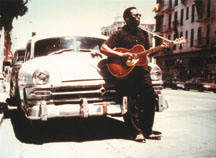
 Joe Louis Walker has long been regarded as one of the leading lights of contemporary blues musicians. As a guitarist he can strap on an electric and slash and burn with the best of them. However, he is equally adept at playing traditional acoustic delta blues. As a vocalist he is known for his passionate and soulful delivery. His is a voice that is equal parts gospel and hard blues. He is a prolific songwriter with an impressive collection of albums to his credit. He is also the leader of the band the Bosstalkers who, with the possible exception of the B.B. King Orchestra, is generally considered to be the best blues outfit of the past decade. In short, Joe Louis Walker is the complete package.
This month Joe will be taking part in a new event called the W.C. Handy All-Star Tour.
It is this region’s good fortune that the inaugural site for this show will be the magnificent Garde Arts Center in New London on Wednesday November 8th. Participating with Joe will be veteran blues guitarist Little Milton, the popular local legend Duke Robillard, vocalist Trudy Lynn, harmonica ace Charlie Musselwhite, and pianist Johnnie Johnson. All six are past Handy winners and nominees. In fact, this year Joe had more nominations than anyone. I had the opportunity to talk with Joe about this and other issues a short time ago.
BH – So tell me about the W.C. Handy tour?
JLW – “I had always believed in strength in numbers. On all of my records, especially ‘Great Guitars,’ I’ve used a lot of people, James Cotton, Taj Mahal, Buddy Guy, all kinds of people. In the old days it was common for five or six acts to get together and I was fortunate to do that on a few occasions. Because personally I think that’s the way the blues is its strongest. The audience is happy they get to hear several artists. The producers are happy because they get to have several artists. And the artists are happy because they get to do a nice compact set and put their best foot forward and they don’t feel as if they have to work all night. There’s a few of these tours going around, the B.B. King summer blues festival comes to mind.”
BH – Strength in numbers probably gets you into these bigger venues too.
JLW – “You know whenever anybody asks me I say there’s a lot of guys playing like Duke Robillard, Billy Branch, Kenny Neal, myself who when we go to Europe we do great but we sort of struggle here to be honest about it. You get rock guys who find their blues roots or make a blues record and a million people go nuts over them. Or you get a boy or a girl wonder who’s 16 or so and they’re making twenty million a year. They’re backed by the Disney channel and all and that’s great, I’m happy for them. But the guys that I call the regulars, guys like myself, Billy, Duke, Charlie Musselwhite, we sometimes got to find an angle. Like Charlie playing with Cuban musicians or something. My friend Alvin Youngblood Hart, he’s got to be able to know every kind of music in the world before he can get up to what I call substantial recognition. But if we can all get together like we’re doing here, it makes it an event.”
BH – You’re like one of those in between guys, you’re too successful to do the club circuit but not big enough yet to fill up the theaters. You agree with that?
JLW – “Believe me my manager Rick Bates says that everyday. That’s the most frustrating thing in the world for him and the main reason I wanted to do this sort of show. The only way I could get into the bigger venues is if I opened up for a bigger act. I remember in the eighties you could open up for a bigger act and they’d pay you 1500 bucks or whatever. Now bigger acts will pay you 500 bucks. I won’t mention any names.
But there’s got to be room for guys like me, and the others I mentioned, and Carl Weathersby and a lot of others. In Europe there’s no problem. We go there every year and thousands of people come out. I know Lucky Peterson was playing with Ray Charles once and headlining with James Brown another time. But I think with a tour like this, we hope it will work every year and I think it will because a lot of people are starting to realize that it’s hard for one artist to sustain a big venue. Also all the older guys are slowing down. The only one that ain’t slowing down is B.B. because he’s a workaholic. I mean if he couldn’t play live, he couldn’t sit in that condo of his in Vegas. Some guys can but he ain’t one of them.”
BH – Changing the subject, you’ve been working a lot with Steve Cropper, what is it that makes him a great guitarist and a great producer?
JLW – “I’ve make three or four records with Cropper and I’ll tell you I didn’t find out how great a guitarist he is until I did a record called ‘The Preacher and the President.’ You see I did this song called ‘Lyin’ in the name of Love’ with the guys down in Muscle Shoals and these guys played on more hits than I played on records And we were just having all kinds of problems with this song. And the guys in the band were saying that we needed a riff. They were asking Cropper ‘could you put a riff on it Crop?’ And Cropper says ‘no you guys are doing pretty good, keep working with it.’ So we found the riff and we played the riff but it still didn’t sound right. So we took a break and we were just sitting around drinking coffee and Cropper goes back into the studio and we heard his guitar and he says ‘o.k. guys come on.’ And the minute he started playing is the minute we cut the song. He has the ability, and it’s hard to describe unless you are in a band, that when he plays it’s almost like everybody in the band steps it up a hundred and twenty percent. He drives the band. He plays the guitar like an organ player and keeps time like a drummer. It’s the damnedest thing. It’s hard to think of rhythm guitar players who can drive the music so hard. After what he did I knew why all those songs were hits with him playing on it because he’s got that intangible that really makes all the musicians around him step it up and really play.”
BH – You mentioned “The Preacher and the President,” The concert takes place the day after we elect a new president. Any thoughts?
JLW – “Yeah, when Clinton came into office, during his span I bought two houses. When George Bush was in office you couldn’t get arrested. I remember like it was yesterday going to Times Square and seeing the big fucking national debt sign going up to the trillions of dollars. So to see that somebody got rid of the national debt and we might actually go back to George Bush junior, who really honestly, in my opinion, doesn’t have the faculties to be President. I tell you I still don’t know why he wants to be president. Do you? I don’t think anybody knows other than it was in his family. My feeling is if it’s working then don’t break it.”
BH – Joe there was some controversy recently involving you with Living Blues Magazine. They totally botched a review of your last record ‘Silvertone Blues.’ You then wrote a letter to the editor correctly pointing out all their mistakes and then a couple months later there you are on the cover. Was that cover their way of apologizing to you?
JLW – “You know what, I couldn’t figure that out. After the review and everything that it represented, and with the letter I had written back to them. Before I wrote the letter my manager came to me and said ‘Man you’re not going to believe this but they have a new editor and he wants you to be on the cover.’ And I said I don’t understand it and to this day I don’t understand it. I don’t know why they did that and it’s amazing because the old editor, David Nelson, he’s the one that wrote the article. He’s the one who said, as he was going out, let’s do the cover on Joe Louis Walker, and the guys coming in had the same idea. It’s just one of those weird things.”
BH- Joe you were in the Bay area during the 60’s and you’re back living there today. What are some of the changes in the music scene there that you’ve noticed?
JLW – “In the sixties everything was a smorgasbord. I used to go to the Fillmore all the time, especially matinees on Sunday. You could see the Howling Wolf, the Grateful Dead, the Charles Lloyd Quartet, and you may have went there for the Dead but you got turned on to the Wolf. And if you were there for the Wolf you got turned on to Charles Lloyd. I remember I got turned on to a lot of acts like that back in the days when the Fillmore was like the Apollo Theatre in Harlem. I got to see all of the acts coming through there, the Temptations when they were hitting their stride, James Brown, Little Richard. I took my grandmother to see Little Richard when he got religion around 1963.
It was a good fertile area and I think that’s why a lot of the musicians that came out of here can play a little blues, a little country. There was a lot of that versatility. FM radio was just beginning. It was here you had Tom Donahue at KMPX and you had Sly Stone at KSAN. Sly was the host for a lot of shows like the Beau Brummels with Marvin Gaye, you know, those cavalcade of stars. And I used to go to those shows. I used to drive Sly’s brother Freddie around so I got a free in to those shows. And my point is that music was not so polarized. Right now music is real polarized, especially in radio. If you can’t get in radio then people can’t hear your records. I don’t care if you make Sergeant Pepper, if they can’t hear it, they can’t like it and they can’t buy it. So now music is so polarized that unless you fit a certain format then you can’t be played on the radio. And you know it’s bad when they’ll play on country radio a guy who sounds like George Jones but they won’t play George Jones. They’ll find a guy who sort of sounds like Merl Haggard but they won’t play Merl Haggard. It’s like that in the blues too. They’ll say we got a sixteen year old white kid that sounds like a sixty-five year old black guy and they’ll play the hell out of him. But they won’t play the sixty-five year old black guy. So that’s kind of the way it is now. It’s almost impossible t get over that barrier, it really is.”
BH- Finally Joe is there a new disc in the works?
JLW – “Well I fulfilled my contract with Polygram slash Verve slash Blue Thumb and I was with them throughout the nineties you know. So there’s a lot of different record companies floating around and I’m thinking I’ll start recording something before this year’s out. After that we’ll make a decision on who we’re going to do what with.”
BH – Joe I’m looking forward to seeing you November 8th
JLW – “Thanks, we’re really looking forward to it.”