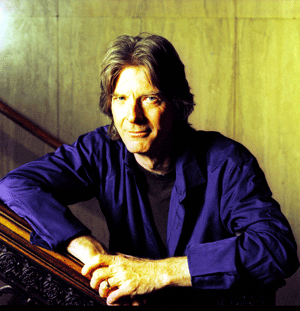
 Turning 60 really was not the landmark birthday it might have been for Phil Lesh.
The Grateful Dead alumnus, now 62, isn’t complaining, though.
He had a life saving liver transplant at 58.
"I guess you could say the big birthday was my 59th one, the very next one (after the operation). At one point there was some doubt I would be around to see that," he explains over the phone from his home in Northern California.
There is ongoing good news on the health front for the bassist, composer and vocalist. "I feel healthy. My recovery really has been quite rapid. The transplant was almost three and a half years ago. I have to say I’m doing pretty darn good."
His gratitude extends to the joy he still takes from making music.
"I never would have dreamed I’d still be doing this at age 60," he says. He points to artists in other disciplines who serve as inspiration on age and creativity. "People like Verdi were well into their 80s and were still massively creative," he reminds.
The many possibilities of the creative process continue to be a powerful lure for Lesh.
He and his band, Phil Lesh & Friends, have just released their debut studio album, "There and Back Again," for Columbia Records. It is Lesh’s first studio sessions since 1989’s "Built to Last," the Grateful Dead’s last studio record, and is Lesh’s first solo recording since "Love Will See You Through," a 1999 live offering featuring an earlier incarnation of Phil Lesh & Friends.
"Luckily we found a company that was interested. I have to give Columbia credit for that," Lesh says.
He says until this album he had never been satisfied with his work in the studio. "It was definitely a challenge to make a real record, not something that was just a bunch of jams, where each song tells a story in a single gesture without any extra frills or noodling."
His band, he says, has fulfilled his wildest dreams. "This is the line-up that has stuck and it just keeps getting better. I’m still excited to be playing with these guys," he says.
"These guys," in addition to Lesh on electric bass and lead and harmony vocals, are Warren Haynes, lead, slide and rhythm guitar and lead and harmony vocals; Jimmy Herring, lead and rhythm guitar; Rob Barraco, keyboards, lead and harmony vocals; and John Molo, drums and percussion.
They really delivered on this album, he says. "They focused down the energy we have on stage live into each song – all those ideas we would have jammed on outside the song and tried to put into the song."
Producer Don |Gehman, whose credits include Hootie & the Blowfish, Bruce Hornsby and the Range, Hot Tuna, John Mellencamp and R.E.M., brought a solid presence to this project, he says.
"It’s part of that concept of telling the story in a single gesture. His tool is to make sure each one of those parts is entertaining and doesn’t repeat too much of what’s been done before, but at the same time is coherent and relates to what’s gone before. I found that to be a delightful approach," Lesh says.
"There and Back Again" also is the songwriting return of Grateful Dead lyricist Robert Hunter, who wrote the lyrics to six of the CD’s 11 tracks.
"He brings a spontaneity and a complete identification with the music you give him," he says. And he works quickly. "He delivered three songs within 48 hours. He is hungry to create," Lesh explains.
For Lesh, writing songs always starts with a musical idea of some kind. "It takes on a life of its own and starts to grow," he says. It is an emotional trajectory, he says.
"Some kind of vague picture or image will arrive along with the musical idea sometimes. That is something that will generate lyrics. That’s in a case when I’m writing lyrics myself. If I can’t focus deeply enough on some kind of lyrical content I take the music to Bob Hunter. By that time it is structured like a song with verse and chorus. I see what he comes up with."
Lesh sees the interest in improvisational music a bright light on the artistic scene.
"It’s the only really interesting thing going on out there. The music industry is pretty boring if you think about it," he says. "I just like to think there is going to be a continuance or an even greater flowering of this kind of music, the more young players who get into it and realize this is a way you can have your cake and eat it too. You can play songs and comment on them and make up music on the spot."
One of Lesh’s goals is to find new ways to take the spirit of the Grateful Dead into the future. "You can’t just do it the same old way because it has been done," he says. "When Jerry (Garcia) was alive he did it the best. My band tries to reinterpret the material."
He believes in treating the Dead’s music as a repertory to be presented in new ways. "Bob’s (Bob Weir) band does the same and the other guys do the same with their bands. Other musicians love Dead music and play it because they love it and want to bring their own perspective to it."
There is really no way to accurately describe the magic that can happen live regardless of what is being played he suggests. "The goal is to put musicians in a state of mind where we aren’t really playing the music," Lesh explains.
"We are opening a door to that eternal music that always exists on another plane. It’s being dictated to us. The door opens and sort of pipes this music through us. We just take that and pass it on."