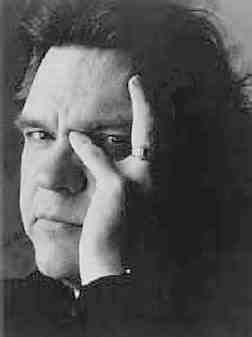
 MEATLOAF
MEATLOAF
By Don Sikorski
He just won’t quit. It’s been over twenty years since FM radio blasted "Paradise By The Dashboard Light", the teenage tale of struggle between lust and commitment. That 1977 debut effort by Meat Loaf, entitled "Bat Out Of Hell", also produced the hit singles "You Took The Words Right Out Of My Mouth" and "Two Out Of Three Ain’t Bad". The album went on to sell millions of copies and continues to remain as one of the best selling rock albums of all time.
Meat Loaf is an unlikely rock and roll star. Born Marvin Lee Aday in Dallas, Texas in 1947, the nickname "Meat" was given to him at the tender young age of nine months and has stuck with him ever since. After high school, he traveled to Los Angeles at the age of nineteen. It was there he went to get a job parking cars at the local theater. Instead of getting that job, he was offered a role in the play itself, performing "Aquarius" in the musical "Hair". His early theater success also helped convince him that he had potential as a singer. His next break came the following year with a movie part as Eddie the Biker in the 1975 cult movie favorite "The Rocky Horror Picture Show". From there, he convinced writer Jim Steinman to collaborate on a musical partnership. Although they often argued over creative control of their initial project, the result, "Bat Out Of Hell", was released in October 1977 and became an instant success. Jim and Meat had hit the big time.
But the pressure to reproduce "Bat Out Of Hell" a second time was more than Meat Loaf and Jim Steinman could manage. As Meat Loaf’s voice struggled to measure up to past performances, Steinman settled for releasing the follow-up project on his own with no success. In 1981, Meat Loaf returned to form and released "Dead Ringer". It also produced poor sales. Meat Loaf soon declared bankruptcy and almost left the music business all together. But rather than quit, he decided to build back his audience, working hard playing small clubs and colleges.
Soon things began looking up for Meat Loaf. "Bat Out Of Hell" began to sell strongly again. Jim Steinman also agreed to re-unite with Meat for a new album. After more than three years of writing, "Bat Out of Hell II: Back Into Hell", was released in 1993. It had been more than fifteen years since their debut collaboration. That record, driven by the top selling single "I’d Do Anything For Love (But I Won’t Do That)", went to number one on the charts and produced a Grammy award for Meat Loaf. He also added another platinum album to his musical resume with 1995’s "Welcome To The Neighborhood." His career had been reborn.
Meat Loaf is one of the hardest working men in show business today. His most recent activities include appearances in two new movies: The Fight Club, co-starring Brad Pitt and Edward Norton, and Antonio Banderas’ Crazy in Alabama with Melanie Griffith. Both movies opened this October. But this is not another typical rock star playing actor story. Meat is quick to clarify the fact that he is much more than some rock and roll musician casually dabbling in an acting role her or there. He has completed ten different movies during the past four years and has appeared in a total of twenty-eight movies in his acting career. "I’m an actor; that’s how I started," he explains. "I love making films. If you go see my work, I’m an actor. You don’t see Meat Loaf, this rock and roll guy, sitting up there. You see the characters. What you won’t see on that screen, in any form, is who you think Meat Loaf is."
He also has a new autobiographical book currently out on the market. Entitled "Meat Loaf: To Hell and Back", the book tells the story of Meat’s musical and acting careers. "It’s not a tell all," he warns, "but I have a lot of stories. People have said that I’m sort of like the real Forest Gump of rock and roll because I’ve met so many people and have had so many interesting things happen to me. Fate has just played my cards for me a lot. You know what to do once you get there, but the dominos have clicked over," he explains. "I mean, the one time, 30 years ago, that I went to get another job, I never got it."
Meat Loaf finds that combining his acting career with his music has helped develop creativity. "Even if I didn’t do films, I would still want to do something creative. Arrange the furniture; I don’t care. Anything that you can make into a creative venture, I think you should do that. I believe that anything that anyone can do that is creative will make them feel better," he promotes.
He and his band will also be touring to promote their most recent effort, "VH1 Storytellers." The Storytellers format fits Meat’s persona to a tee. He appears completely at home with the audience-participation format, as evident by his producers having the stories on the new disc cut from over two hours down to about eleven minutes. He also plans to utilize this format on his upcoming tour. "It should be like nothing you’ve ever seen before," Meat Loaf predicts. "The only way you’re going to hear a song is if someone talks to me," he warned. "And we are prepared to play any song that I have ever recorded. It will be like going to a party in my living room. It’s very interactive, like everybody has a backstage pass."
Meat Loaf is a multi-dimensional entertainer that brings a great deal of enthusiasm to the table. He puts his heart and soul into every performance. He also has developed a deep sense of appreciation for his audiences. "I love my work," said Meat. "And I’ve been very fortunate in 32 years never to have had another job."
In his career, he has sold over 50 million records, filed for bankruptcy, and then returned to produce a number one record. And in a day and age where rap, hip-hop, and alternative grunge music dominate the charts, Meat Loaf is at the top of his game and is better and more popular than ever. "Bat Out of Hell" has now sold over 30 million copies worldwide, making it one of the top selling albums of all-time. Meat Loaf will also be bringing his Storytellers show on the road. The show promises to be special. "It’s very improvisational; the whole evening," he explains. He also offers the opportunity for the audience to be involved in the show. "If nobody says anything to me, then we’ll sit there and look at each other for an hour and a half. The show will end when the curfew of the building ends."