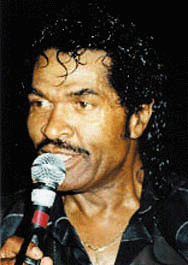
 When David Pottie, editor of, and spirit behind Sound Waves, called me to do a cover story for his magazine I had planned on featuring someone other than Bobby Rush. However, when I discovered that Bobby was going to be performing in the area (Symphony Space on Broadway in New York City) this November 17th, I changed my mind. After seeing the Bobby Rush show in Memphis two years ago, and interviewing him for my radio show, I decided that in the future I would do whatever I could to make more and more music fans aware of one of this country’s national treasures. Bobby Rush.
Bobby’s history is truly incredible. One of his earlier bands in Mississippi featured Elmore James on guitar. He played with and hung out with Muddy Waters, Howlin’ Wolf, and Luther Allison, just to name a few. But it is his musically tight, energetic, and very risqué stage show that sets him apart. Accompanied by at least three voluptuous female back-up dancers, and a band that makes hits like they’re playing with James Brown, Rush combines elements reminiscent of both Sonny Boy Williamson and Otis Redding, to create a unique world on stage. A world full of suggestive double-entendre, sexual high-jinks, and straight ahead blues.
Some critics, perhaps a little over-whelmed by the bawdy presentation, just don’t get it. But Bobby Rush is not about to change his style. Bobby honed his show over many years on the Chitlin’ Circuit where he became close personal friends with B.B. King, Little Milton, Bobby Blue Bland and especially Rufus Thomas, and therein lays his authenticity. At one point during our interview we talked about the stylistic elements of his show.
James Montgomery: Your show is very high energy, fun and you’ve got some young ladies up there with you.
Bobby Rush: I didn’t notice, there were ladies up there (laughter). You noticed that?
JM: At one point, Bobby, I stopped noticing you (even more laughter).
BR: Now you’re bustin’ my bubble, ‘cause I thought you were comin’ to see my show.
JM: Well I was until they got up there (laughter)
BR. Well, I planned it this way. Because what I do is try to give people the show. Let me tell you a little story. I was down three or four years ago when I went to Amsterdam, and Luther Allison was on the show, in fact he was the headliner. There was probably twelve or fifteen artists on the show, most of them was black entertainers, and I had been advertised as (nothing other than) a Blues singer, and when I went up I literally got booed for what I did. But since that time, the same people that booed me is eating me up now. The point I’m getting’ to is that when I saw these bands, what hurt me so bad, must have been twelve of them that played “Sweet Home Chicago”, or “Mojo Workin’”, and I said to myself “If I hear another ‘Mojo Workin’’ or ‘Sweet Home Chicago”, I’m goin’ to kill myself. I was disappointed about the guys who sold out to play music because they thought that the white guys or the white women would like this. You see I remember as a young man when Muddy Waters and Howlin’ Wolf were recordin’, they weren’t recordin’ somethin’ sayin’ let me record this just because I think it’s going to be a crossover, I think the whites goin’ to like this, or the black’s goin’ to like this…no… you record good music. You record what you love.
JM: That was Bonnie Raitt’s advice to Maria Muldaur!
BR: And when I’m on the stage , I don’t do my show for no white audience or no black audience, I’m havin’ fun and that’s what’s happenin”
Bobby’s show is more than just fun however. He is a gifted Blues artist who sings well and plays great harp. His decision to focus on harmonica came about when he was with Little Walter, legendary harpist with the Muddy Waters Band.
Eventually, Bobby’s harmonica playing expertise would lead to some work on some of Jimmy Reed’s records.
BR: I would be the runner (on the Jimmy Reed recording sessions at Vee-Jay studios) and go get the coffee and donuts and the whole bit, in order to get the experience in the studio, to see the recording, hopefully that I would be recording one day. But when I look back on it they had never planned to record me. I was a guy to bail Jimmy Reed out if they needed me (if Jimmy got too drunk).
JM: So if Jimmy got into a state where he couldn’t actually finish…
BR: Then I would come and play the harmonica. I could imitate him, play like Jimmy Reed. Like the song “Hush Hush”…that’s Bobby Rush
So the Jimmy Reed sessions may have been Bobby Rush’s first recording experiences, but he now has some twenty one releases of his own. He is the consummate live entertainer who has influenced both Tina Turner and James Brown. He is in fact a national treasure. It’s a matter of Congressional Record. Here is a portion of the transcript of the proceedings of the 105th congress dated October 1, 1998.