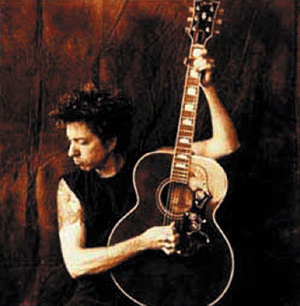
 I was a little nervous about meeting Ricky Byrd. This was going to be my first face to face interview for Soundwaves after three previous phoners. But I knew there would be a lot to talk about because Ricky has played guitar with some of the biggest names in contemporary music. People like Ian Hunter, Roger Daltrey, Steve Marriott, John Waite, G.E. Smith, and most notably Joan Jett have all jammed with Ricky. Now Ricky is performing his own songs and recording his first solo CD. It was at the Acoustic Café in Bridgeport, Connecticut where we had this talk.
PH – When I think of the song ‘I Love Rock And Roll,’ I used to think of the Blackhearts in that cool black and white video. Now I see Britney Spears doing the song. Do you want to kill her?
RB – “No but the only thing that bothers me about that is that they interviewed her and asked ‘why did you do that song?’ She said ‘because I always loved Pat Benatar.’ That’s what I heard. I guess it was a compliment that she wanted to do it. Whether I think she did a good job or not…there’s nothing like our version. I don’t think she gets what the song is. It changed my life. If you remember 1981, there was no music like that on the radio. That was crunchy guitars. At that time you had J. Geils ‘Centerfold’ and Michael Jackson. There wasn’t a lot of crunchy rock and roll guitar. So for me that song meant a lot because it changed radio back then. It opened the door for that kind of music again. Music goes through changes and radio goes through changes and then somebody comes back and plugs a Les Paul into a Marshall and there you go again.”
PH – What did you use to get your guitar sound?
RB – “I use a black Les Paul that I called Pappy. It actually says that on the back of it. Somebody spray painted it. It’s a black Les Paul Pro Deluxe through a Marshall 100 watt with two tubes taken out, which was my way of making it a 50. That’s it. Straight in, no peddles, no nothing.”
PH – You were the backbone of the Joan Jett sound.
RB – “Well, we were both the combo. As far as I know her influences were the Glitter bands. Gary Glitter, Suzy Quatro, that kind of music. Mine was more of the Rolling Stones. I grew up on the Faces. I think that was the sound, me playing around her. That was the combo.”
PH – You were with Joan for 11 years. How did it end and what did Joan say?
RB - “Well, there were a couple of years where she felt I abandoned ship. I took a while for us to sit down and talk about it. It was just me ready to leave. All the stuff I like in rock and roll comes from soul. All the bands I liked had the taste of Otis Redding and Al Green. When I would write, all my songs would lean towards that and my melodies were all kind of soulful. I was drawing from that well of soul singers. So, I always say, when you’re standing in front of 80,000 people and you’re thinking about something else, there’s a problem. I had the greatest run with her. It was everything I wanted when I was thirteen years old. We had a number one record. We traveled the world. We played practically every stadium in the country. We didn’t play Yankee Stadium though and I’m a big Yankee fan. But, playing for 80,000, you get used to it. You’re wondering, will I get back to watch David Letterman? So I figured it was time to move on. There were other things that I wanted to do. I wanted to front my own band and write songs.”
PH – Besides Joan Jett you were also a sideman for Roger Daltrey and Ian Hunter. If there was one person you could be a sideman for, who would it be?
RB – “I would love to play guitar with Rod Stewart if Rod was still doing that stuff like ‘Every Picture Tells A Story.’ That’s my blood. But I got to play with Roger Daltrey and that was unbelievable. He cut a couple of songs that I co-wrote. Funny, once I left the Blackhearts I wanted to do my own thing but as soon as I got out of the band I got a call from Roger….out of nowhere. Actually it was from my friend who was producing his record. He said ‘we’re jamming at a club in the city. Why don’t you come down? I’d like you to get to know Roger.’ At the club we got up there and did ‘I’m A Man’ and I think a Who song. Then we got to be friends. It was all a little con to get us together so I’d be on his record. That happened immediately after I left the Blackhearts. Then, when I was done with Roger, I got the call from Ian Hunter. I remember going up to Ian in clubs in the 80’s, drunk, saying ‘Man you should get me to play guitar for you. I would love to play those songs!’ Now, he calls me and invites me to his house to work on some stuff. Then he tells me he’s getting ready to do this tour. So all these things are stopping me from doing my thing, but you’re not going to say no to these people you grew up on. I stood in line for three hours at Forest Hills Tennis Stadium to see The Who do the ‘Who’s Next’ album. Whoever thought I’d be playing guitar with Roger Daltrey! As for Ian, I remember hanging out at Max’s Kansas City. That’s where I hung out. That’s where I learned everything about rock and roll. I was a kid and I remember seeing Mott The Hoople at the Uris Theater in 1973, and after the show I stood behind Ian and the band at Max’s and just stared at them. Then, twenty years later, I’m in London on stage with Ian playing ‘All The Young Dudes.’ The hairs on my arms were standing straight up! So, if I could play guitar for someone…..Rod Stewart. Anyone else? Well, would you like to be in the Stones? Yeah. Oh, another would be Robin Zander of Cheap Trick. And unbelievable singer. He chain smokes like there’s no tomorrow and he sings like a bird to this day. I’d like to play guitar with him but I think they got somebody.”
PH – Yeah, that guy with the hat. OK, as a frontman, who would you pick as your sideman?
RB – “I can’t tell you exactly. There’s a guy named Andy York that plays with John Melloncamp. He’s one of his guitar players. When I left the Blackhearts, and after all the things with Roger and Ian, I tried to put together a couple of rock and roll bands. I was looking for the right guys. Andy was one of the guys I found in New York. He played wide open. Of all the guys I found, he was the one who sat down and really wanted to work. So Andy York was just a stand up guy and a great guitar player. Listen to those last couple of Melloncamp records. He’d be my sideman.”
PH – Lets talk about your new CD. Did you write all the songs on your Gibson J-200?
RB – “Yeah, I think so. I have that and I have an old Gretch by my bed.”
PH – Is the CD going to be acoustic?
RB – “No, here’s the story. For a while I was trying to get a band going. It wasn’t working out and I was getting really depressed because I couldn’t get it together with the right people. So Carol Kaye, my manager, says to me, ‘why don’t you take your J-200 and go out and play?’ Now, I’m not that guy who played Beatle songs at parties, but my back was against the wall. I went to songwriters night, signed in, played my three songs and was scared to death. It’s harder to play for a small room of people than it is to play for 100,000. But after a while it was cool. Wow, no band, no headaches, no tour. Now, because I’m alone, I got to start writing differently to fill out the sound. So I start writing different kinds of songs. Now all of the sudden I don’t sound like a Rolling Stones band. Now it’s my music. It would have never happened if I stayed electric. This made my a good entertainer. I can tell stories and do what I like. Now, how did I get to making this CD? I love Steve Earle. He has the sound I want. A big acoustic guitar, great vocals, electric guitars, analog rock and roll. I looked at one of his covers and I see – produced by Ray Kennedy. So I make a trip to Nashville and go to a Steve Earle show. I give him my rap and he says, ‘it’s all about songs and I work analog.’ OK, I send him 36 songs and we narrow it to 15. He gets me Dane Clark, the drummer from Melloncamp’s band. A great bass player named Brad Jones, and that’s my band. Is it acoustic? Is it electric? It’s both. We have Wayne Jackson from the Memphis Horns. He played on Al Green’s albums, on Otis Redding’s albums, and on Wilson Pickett’s albums. The history is there! I was thrilled to have that guy.”
Ricky and I talked some more. Here’s a guy who has seen the world and lived the rock star life. Yet, when he talked about people like Roger Daltrey, Otis Redding, and David Wells, he spoke very highly of them. He also showed the same respect when he talked about people that were not so famous. Ricky Byrd is a great singer/songwriter and a class act. We’ll be hearing a lot more from him and soon.